
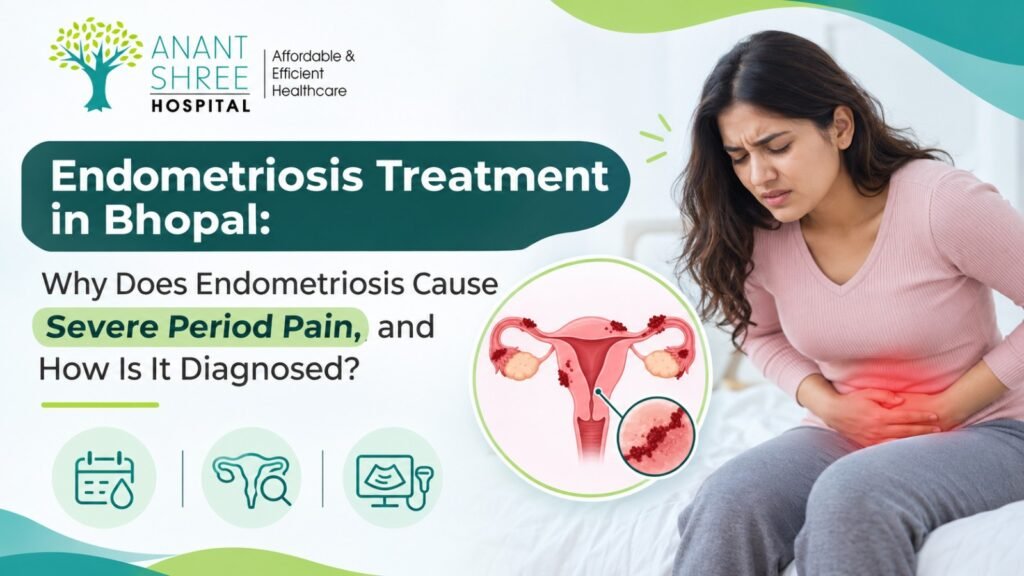
Endometriosis Treatment in Bhopal: Why Does Endometriosis Cause Severe Period Pain, and How Is It Diagnosed?
Severe period pain can affect a woman’s ability to work, study, sleep, and complete everyday activities. While mild cramps are common during menstruation, repeated or intense pain should not be ignored. One possible cause is endometriosis, a condition in which tissue similar to the lining of the uterus grows outside it. Endometriosis may affect the ovaries, fallopian tubes, and other areas inside the pelvis. These growths can respond to monthly hormonal changes and may cause inflammation, irritation, and pain. Some women experience discomfort only during periods, while others may have pelvic pain throughout the month. Understanding the symptoms and diagnosis process is important when considering Endometriosis treatment in Bhopal. A gynaecologist can review menstrual history, assess the pain pattern, and recommend investigations when needed. Women looking for a Gynecologist in Indrapuri Bhopal can discuss their concerns with Dr Divya Batra at Anant Shree Multispeciality Hospital, Indrapuri, Bhopal. What Is Endometriosis and How Does It Affect a Woman’s Body? The uterus has an inner lining that changes during the menstrual cycle. If pregnancy does not occur, this lining sheds and leaves the body through menstrual bleeding. In endometriosis, tissue similar to this lining grows outside the uterus. It may develop around the ovaries, fallopian tubes, or the lining of the pelvis. In some cases, it may also affect areas near the bladder or bowel. This tissue can respond to hormonal changes during the menstrual cycle. The surrounding areas may become irritated and inflamed. Over time, some women may develop scar tissue or adhesions. These are bands of tissue that can cause nearby organs or structures to stick together. The condition does not affect every woman in the same way. Some experience severe pain, while others have mild symptoms or no noticeable discomfort. The amount of pain does not always indicate how much endometriosis is present. Understanding these changes is an important part of Endometriosis treatment in Bhopal. A medical assessment can help identify whether the symptoms may be related to endometriosis or another condition. Why Does Endometriosis Cause Severe Period Pain? During menstruation, the uterus contracts to help remove its inner lining. These contractions can cause cramps in the lower abdomen. In women with endometriosis, tissue outside the uterus may also react to monthly hormonal changes. This can lead to inflammation and irritation in the pelvic area. Scar tissue may develop in some cases and affect nearby structures. These changes can contribute to pain during periods and at other times of the month. Some possible reasons for severe pain include: Inflammation: Irritation around endometriosis growths can make nearby tissues painful. Hormonal changes: The growths may respond to the hormonal changes that occur during the menstrual cycle. Scar tissue: Adhesions may develop and cause nearby organs or tissues to stick together. Pressure on nearby structures: Growths or scar tissue may affect surrounding organs. Pain sensitivity: Some women may develop increased sensitivity to pain in the pelvic region. Pain may begin before menstrual bleeding and continue during or after the period. Some women also experience discomfort between periods. When pain repeatedly affects daily activities, discussing Endometriosis treatment in Bhopal with a qualified doctor may help identify suitable next steps. What Are the Common Symptoms of Endometriosis? The symptoms of endometriosis can vary. Some women mainly experience painful periods, while others notice pelvic discomfort, digestive symptoms, or pain during everyday activities. Common symptoms include: Severe menstrual cramps: Period pain may be stronger than usual and can interfere with daily activities. Pelvic pain: Discomfort may occur before, during, or after menstruation. Lower back pain: Pain in the pelvic area may sometimes spread towards the lower back. Pain during intercourse: Some women experience deep pelvic pain during or after sexual activity. Heavy menstrual bleeding: Some women report heavier periods or spotting between periods. Pain during bowel movements: Discomfort may occur while passing stool, particularly during menstruation. Pain during urination: Some women experience discomfort while passing urine. Difficulty becoming pregnant: Endometriosis may affect fertility in some women, although many women with the condition conceive naturally. These symptoms can also occur with other health conditions. They should not be used alone to confirm endometriosis. Women looking for an Endometriosis doctor in Kalpana Nagar Bhopal should discuss their symptoms and medical history with a qualified gynaecologist. How Is Normal Period Pain Different from Endometriosis Pain? Mild or moderate period cramps are common. They usually occur because the uterus contracts during menstruation. In many women, the discomfort improves with rest, warmth, or suitable pain-relief medicines. Endometriosis-related pain may be more intense or last longer. It can begin several days before the period and continue after menstrual bleeding ends. Some women also experience pain outside their menstrual cycle. Normal period pain Possible endometriosis-related pain Usually lasts for a limited time May begin before periods and continue afterwards Often improves with simple pain-relief measures May continue despite usual pain-relief measures Usually does not disturb daily activities May affect work, sleep, or everyday routines Mostly occurs during menstruation May also occur outside menstrual days Commonly involves lower abdominal cramps May include pelvic, back, or bowel-related pain These differences are general examples and cannot confirm a diagnosis. Fibroids, ovarian cysts, pelvic infections, and other conditions can also cause pelvic pain. Women searching for Severe period pain treatment in Ayodhya Nagar Bhopal should not assume that intense cramps are normal. A medical evaluation can help identify the possible cause and guide further care. What Causes Endometriosis and Who Is at Risk? The exact cause of endometriosis is not fully understood. Researchers believe that a combination of hormonal, genetic, immune system, and other biological factors may contribute to the condition. Some possible factors include: Family history: Endometriosis may occur more often in women who have a close family member with the condition. Hormonal activity: Oestrogen plays a role in the growth of endometriosis-related tissue. Immune system factors: Differences in immune system activity may influence how the body responds to tissue growing outside the uterus. Cell changes: Certain cells may change into tissue that behaves like